

Landmark Report Reveals Labour Rights Gap for Sea Workers in Europe
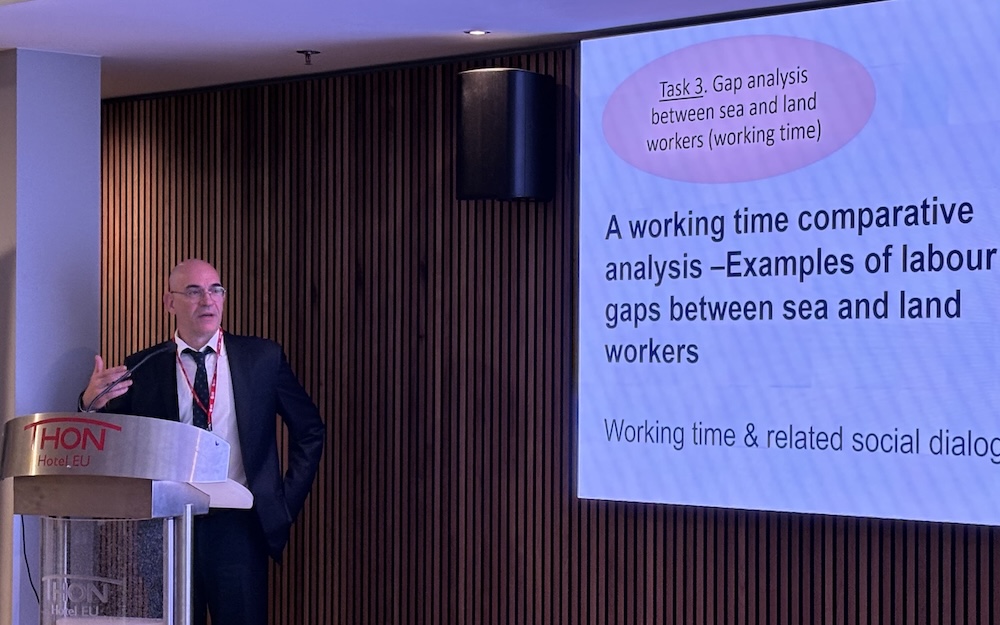
A major new report titled “Charting the Distinct Rights of Sea Workers in European Waters: A Focus on Decent Working Time”, was released by the World Maritime University (WMU) on 27 May. Commissioned by the European Transport Workers’ Federation (ETF) and the International Transport Workers’ Federation (ITF), the study is primarily driven by the differential treatment of sea workers compared with land-based workers, which has resulted in their exclusion from several EU directives and in working and living conditions that fall below general labour standards. The report highlights major gaps between the labour protections afforded to sea workers and those enjoyed by land-based workers across Europe.
Livia Spera, ETF General Secretary said, “The key findings of the WMU report were not surprising, but are still shocking. We’ve said most of this before, but now it is time to look at the root causes and act. ETF strongly believes that the coming discussions at the ILO IMO Joint tripartite WG represent a critical opportunity for needed regulatory reforms, including the MLC and STCW regimes in rest/work hours. The EU could and should take a leadership role in supporting and promoting stronger international protections for sea workers. A sustainable maritime sector requires that sustainability, competitiveness and labour standards advance together.”
Professor Maximo Q. Mejia, Jr., President of the World Maritime University said, “The report reviews and examines gaps between maritime working time standards and the ILO’s and EU’s reference framework for other workers. The labor regulatory framework for seafarers must ensure a safe and decent workplace at sea supported by, among other things, scientifically-informed and clearly-articulated working time standards consistent across all sectors. Ensuring decent working and living conditions is an imperative to safeguarding seafarers’ rights, promoting safety at sea and sustaining the maritime industry.
Sea workers continue to work in conditions that simply would not be acceptable in most other land-based sectors, including other transport sectors.
The report reveals that current maritime governance favors commercial and operational interests over occupational safety, health, and decent work standards, with the researchers concluding that chronic overwork threatens both seafarers’ well-being and maritime safety. With the support of an abundant literature, the researchers conclude that chronic overwork threatens both seafarers’ well-being and maritime safety.
Normalisation of excessive working limits and the “Minimum hours of rest” standards apply for those at sea. The existing legislative framework allows sea workers to work up to 91-hours per week.
As revealed by a WHO/ILO Joint Estimates of the Work-related Burden of Disease and Injury, 2000–2016, exposure to long working hours (≥55 hours/week) causes large attributable burdens of ischemic heart disease and stroke, but the research finds an average of 74.9 hours / week, far beyond what ILO considers as decent working time (48 hours per week) and far beyond the global average of 43 hours/week for worldwide land based workers.
· 53.3% of sea workers work more than 72 hours/week (very very long hours)
· 11.7% more than 91 hours/week (beyond MLC, 2006 compliance level)
Maritime workers do not have working time provisions about night work limitation contrary to other workers.
A fatigue criteria analysis shows that no regulation addresses all eight fatigue-related criteria for transport workers:
· Land workers addresses 3 criteria (including time of day)
· Aviation, road and rail address 6 criteria (including time of day)
· Inland waterways addresses 2 criteria (limitations related to night work and short breaks)
· Shipping and fishing address 0 criteria
Long working hours, insufficient rest and disrupted sleep directly impact concentration, decision-making, situational awareness and increase risks of human error and risks for crews, vessels, cargo, passengers and the marine environment.
At the same time, there is very worrying evidence that long hours, insufficient rest, and disrupted sleep patterns are linked to a range of serious health problems, including cardiovascular risks like heart disease and potentially heart attacks.
Beyond fatigue and working time, the study highlights the important gaps in the protection of sea workers within the EU labour framework, showing that seafarers remain excluded from several horizontal EU labour instruments, creating uncertainty and weaker protections compared with land-based workers.
The study also highlights the need for a critical reassessment of how jurisdiction and applicable law are determined for sea workers. In private employment disputes, the jurisdiction of the Flag State is no longer fit for purpose.


