

Transforming Shipping in Practice - WMU Maritime Affairs Conference 2026
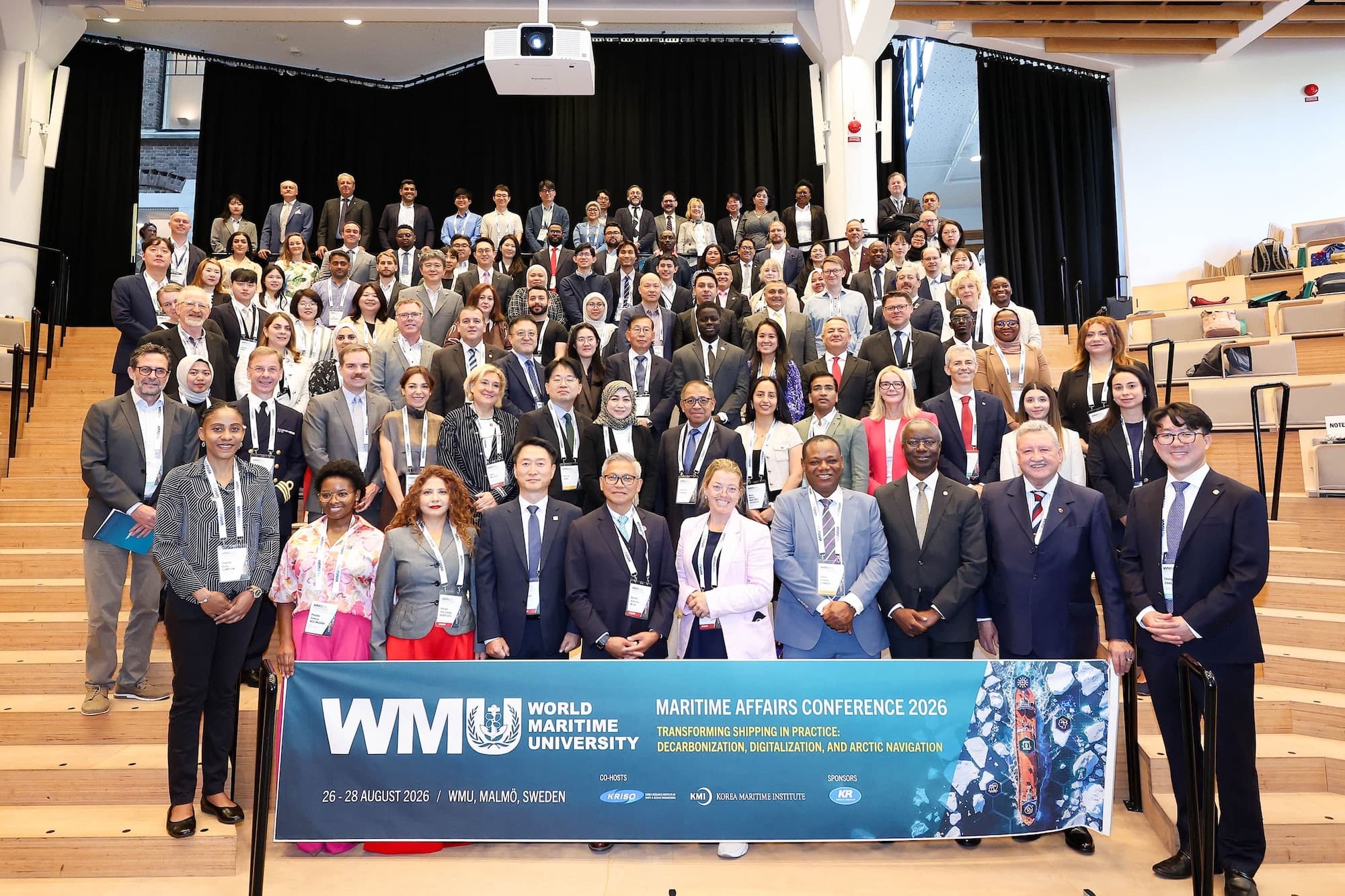
From 26 - 28 August, the World Maritime University (WMU) Maritime Affairs Conference 2026 brought together experts from industry, academia, government and international organizations to examine how the maritime sector can translate transformation into practice amid accelerating regulatory, technological and environmental change.
Held under the theme Transforming Shipping in Practice: Decarbonization, Digitalization, and Arctic Navigation, the three-day Conference explored the practical interaction of technology, regulation and policy in addressing key challenges shaping the future of shipping.
Opening the Conference, WMU President Professor Maximo Q. Mejia, Jr. welcomed participants and highlighted the importance of dialogue and collaboration in addressing the complex challenges facing the maritime sector. Keynote remarks from IMO Secretary-General Arsenio Dominguez, Alexandra Anstrell, Chair of the Arctic delegation in the Swedish Parliament and Chair of the Conference of Parliamentarians of the Arctic Region, and Jongjin Jung, President of the Korea Research Institute of Ships & Ocean Engineering (KRISO), and Sung-Soon Yoon, Vice-president of Korea Maritime Institute, further underscored the international nature of the discussions.
The Conference explored three interconnected themes—maritime decarbonization, maritime digitalization and Arctic navigation—reflecting some of the most significant technological, regulatory and environmental developments shaping the future of shipping. Across the three themes, discussions highlighted the importance of considering technology, regulation and policy together to support practical and sustainable transformation.
Under the topic of maritime decarbonization, speakers addressed international shipping decarbonization and the importance of policy pragmatism, as well as safety assurance for maritime’s dual transformation. Sessions examined approaches to reducing GHG emissions, including green shipping corridors, alternative and synthetic fuels, onboard carbon capture, green bunkering, and technologies such as physics-informed machine learning to support ship performance and decarbonization.
Maritime digitalization was explored through its human, regulatory and technological dimensions. Speakers addressed the role of human operators in advancing maritime autonomy and Artificial Intelligence, the skills needed for increasingly complex maritime systems, digitalization in maritime education and training, cyber risk governance, and legal issues associated with autonomous ships and electronic documentation.
Arctic navigation provided a focus on the rapidly changing operating environment in the region and its implications for safety, environmental protection, geopolitics and international cooperation. Presentations considered the co-evolution of Arctic shipping and geopolitics, marine safety and environmental protection, autonomous shipping in polar waters, voyage planning and navigation tools that take into consideration marine biodiversity protection, Arctic search and rescue, and future technology for Arctic shipping. The sessions also considered Sweden’s Arctic strategy and its upcoming Chairship of the Arctic Council.
Across the three themes, a recurring focus was the need to connect technological development with appropriate regulation, effective governance and practical implementation. The Conference provided a platform for participants to exchange perspectives across disciplines and sectors, highlighting the importance of cooperation in developing solutions that are both innovative and workable in diverse maritime contexts. The Conference also marked the 25th anniversary of the WMU Journal of Maritime Affairs, with a dedicated session examining the Journal’s contribution to maritime scholarship and looking towards the future of maritime research.
This year’s event was co-hosted by the Korea Research Institute of Ships & Ocean Engineering (KRISO) and the Korea Maritime Institute (KMI) with sponsorship from the Korean Register (KR). It is the third annual WMU conference focused on Maritime Affairs more broadly, serving as a platform for open dialogue, mutual understanding and collaboration among experts from industry, academia and policymaking communities. Through its focus on the intersection of technology, regulation and policy, the Conference aims to generate practical and academic outcomes that support the transformation of the maritime sector and contribute to the United Nations Sustainable Development Goals.


